In this article
At a glance
- Operation: deep plane facelift under general anaesthesia, usually 3 to 5 hours
- Hospital stay: 4 nights in a private hospital in Istanbul
- Time in Turkey: plan for about 5 to 10 days
- Social downtime: usually 2 to 3 weeks
- Final result: settles over 6 to 12 months
- Price: a fixed, written quote after your surgeon reviews your photos
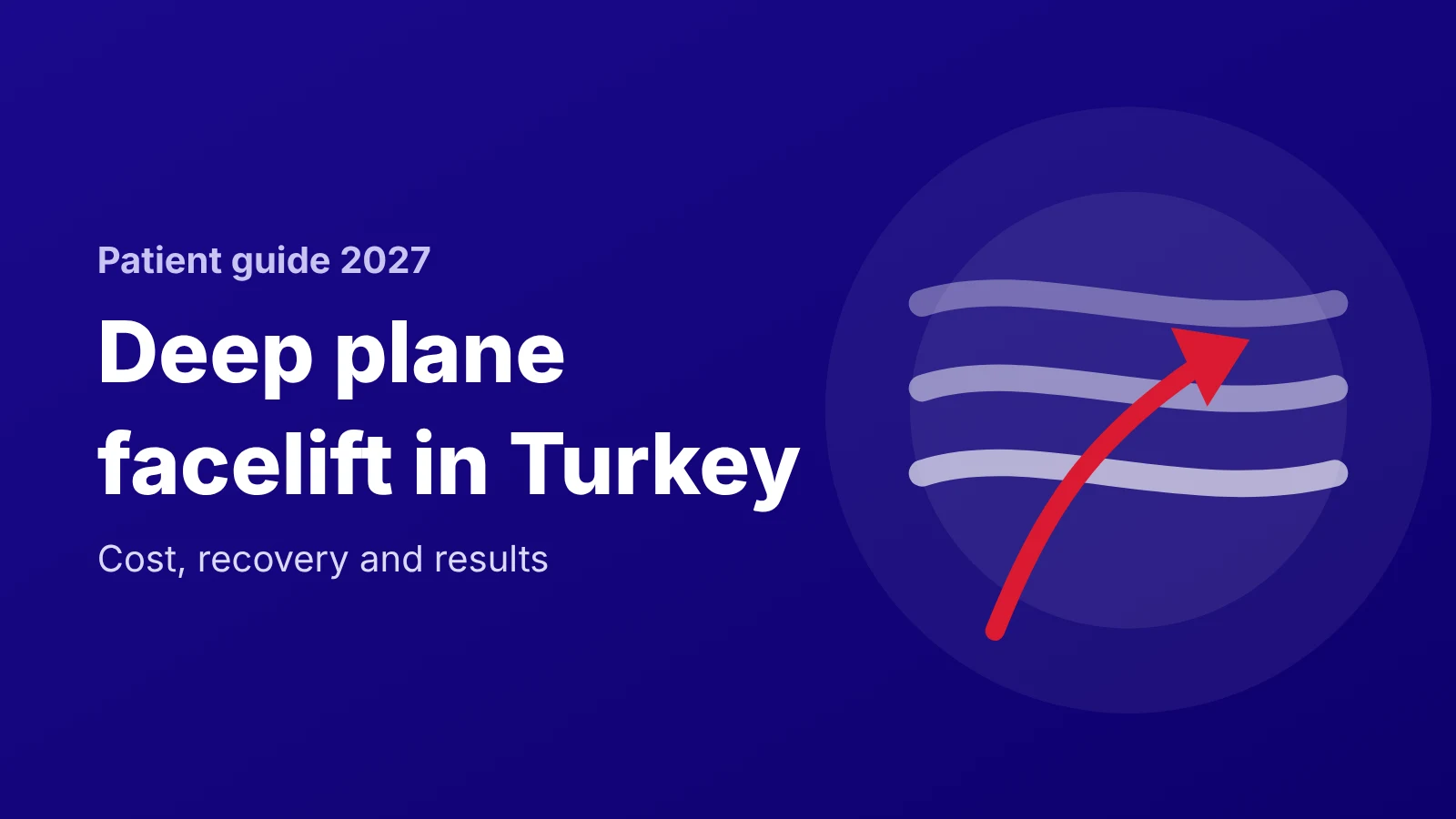
A deep plane facelift is the technique most people mean when they talk about a natural-looking facelift today. Instead of pulling the skin tight, the surgeon releases and repositions the deeper tissues of the face, so the cheeks, jawline and neck are lifted together and the skin sits on top without tension.
This guide explains how the operation works, who it suits, what your trip to Istanbul looks like, how recovery feels week by week, and what results you can realistically expect.
What is a deep plane facelift?
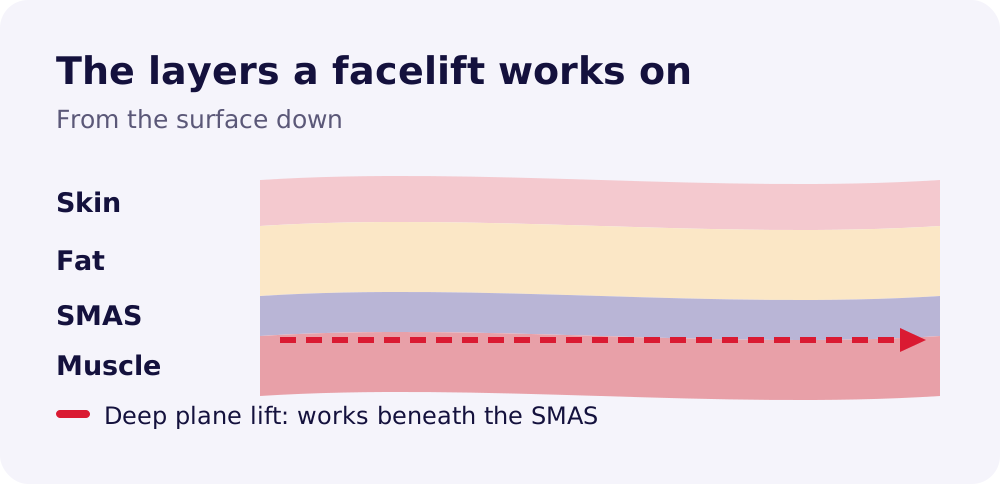
Under the skin and fat of your face is a layer of fibrous tissue called the SMAS (superficial musculoaponeurotic system). It is connected to the muscles that create facial expression. As we age, this layer and the fat pads that sit on it descend, which creates jowls, deeper folds from the nose to the mouth, and a softer jawline.
In a deep plane facelift, the surgeon works beneath the SMAS. Key ligaments that hold the tissue down are released, and the face, cheek and neck tissues are lifted as one unit. Because the deep layer carries the lift, the skin itself does not need to be pulled tight.
The result is a lift that looks rested rather than "done": the cheek volume moves back up where it used to be, the jawline becomes sharper, and the neck is tightened without a windswept look.
What can a deep plane facelift improve?
- Jowls and a blurred jawline
- Loose skin and bands in the neck, especially when combined with a neck lift
- Deep nasolabial folds between the nose and the corners of the mouth
- Flattened cheeks where the mid-face has descended
A facelift does not change fine lines on the skin surface, the area around the eyes or the forehead. These are often treated at the same time with eyelid surgery, a brow lift, fat transfer or skin treatments, if you want them.
Who is a good candidate?
Most patients are between their mid-40s and early 70s, but age matters less than the face itself. You may be a good candidate if:
- you have visible jowls, neck laxity or mid-face descent
- you are in good general health and at a stable weight
- you do not smoke or vape, or can stop for at least 4 to 6 weeks before and after surgery
- you want a natural refresh rather than a different-looking face
Smoking and nicotine reduce blood flow to the skin and significantly increase the risk of wound healing problems after a facelift. Uncontrolled high blood pressure increases the risk of bleeding. Your surgeon will ask about both, along with any blood thinners or supplements you take.
How much does a facelift cost in Turkey?
The price of a facelift depends on what you need. A deep plane facelift on its own is priced differently from a facelift with a neck lift, eyelid surgery or fat transfer. That is why Booking Surgery gives you a fixed, written quote after your surgeon has reviewed your photos, rather than a headline price that changes later.
Your facelift package includes:
| Included | Not included |
|---|---|
| Consultation with your plastic surgeon | Flights |
| Pre-operative tests and anaesthesia review | Travel insurance |
| The operation under general anaesthesia | Procedures not listed in your plan |
| Private hospital room for 4 nights, with nursing care | |
| Medication and meals | |
| Airport and hospital transfers, and a translator | |
| A companion can stay with you at no extra cost | |
| Stitch removal and a final check before you fly |
Facelift prices in Turkey are typically a fraction of private prices in the UK and Western Europe, largely because hospital and staff costs are lower. Compare quotes by what they include, who operates and how aftercare works, not by the headline figure alone.
Your trip to Istanbul
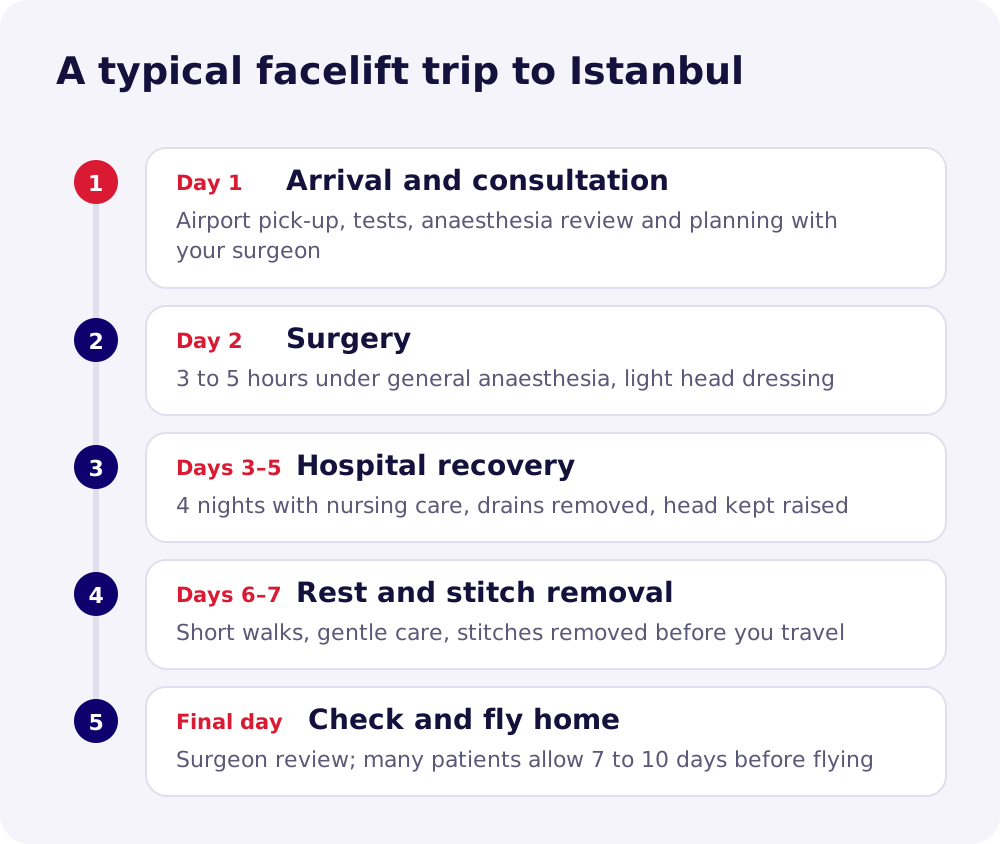
Arrival and consultation
Your driver meets you at the airport. At the hospital you have blood tests and an anaesthesia review, then sit down with your surgeon. You will look at your face together in a mirror and agree exactly what will be done. Your translator stays with you throughout.
Surgery
The incision starts in the hairline at the temple, runs in the natural crease in front of the ear, curves around the earlobe and ends behind the ear in the hairline. If a neck lift is included, a small incision under the chin may be added. The operation usually takes 3 to 5 hours. A light head dressing and sometimes small drains are placed at the end.
Hospital recovery
You stay in hospital for 4 nights. Your face will feel tight, swollen and bruised, and you rest with your head raised. Nurses manage your pain, check for bleeding and remove drains, usually within a day or two.
Rest and final check
Stitches are removed and your surgeon checks your healing before you fly home. The NHS advises waiting 7 to 10 days after facial cosmetic surgery before flying, so many patients plan a slightly longer stay. Ask your surgeon what is right for you.
Recovery, week by week
| When | What to expect |
|---|---|
| Days 1 to 3 | Tightness, swelling and bruising are at their peak. You rest with your head raised and avoid bending. |
| Week 1 | Swelling starts to settle. Drains and most stitches are removed. Short walks are encouraged. |
| Weeks 2 to 3 | Most bruising has faded. Many people return to desk work and video calls, and use make-up to cover any remaining marks. |
| Weeks 4 to 6 | Gradual return to exercise. Numbness around the ears and cheeks usually starts to improve. |
| Months 3 to 12 | The last swelling resolves, the face softens, and scars fade from pink to pale. |
Sleeping on your back with your head raised, avoiding heavy lifting and protecting your skin from the sun all help your recovery. Your coordinator stays in touch after you get home, and you can send photos so your surgeon can check your progress.
Risks and how they are managed
- Haematoma. A collection of blood under the skin is the most common early complication, usually in the first 24 hours. This is one reason you stay in hospital, where it can be treated quickly.
- Nerve changes. Numbness of the skin is normal and improves over months. Weakness of a facial muscle is uncommon and usually temporary; permanent nerve injury is rare.
- Wound healing problems, which are much more likely in smokers.
- Scarring and asymmetry. Scars are placed in natural creases and the hairline, and usually fade well, but every face heals differently.
- Infection and blood clots, which are uncommon and reduced with good surgical care and early walking.
Get medical help quickly if you notice
- swelling that is much worse on one side, or rapidly increasing
- increasing pain, or redness and heat spreading from a wound
- fever, or a wound that discharges pus
- shortness of breath, chest pain, or a painful swollen leg
Contact your local emergency services first, then let your Booking Surgery coordinator know.
How long do the results last?
A deep plane facelift turns back the clock rather than stopping it. Your face continues to age from its new starting point, so you will still look younger than you would have without surgery years later. Many surgeons describe the effect as lasting around a decade or longer, but it varies with your skin quality, genetics, sun exposure, smoking and weight changes.
Looking after your skin, keeping a stable weight and not smoking are the most useful things you can do to keep your result for longer.
If you are comparing techniques, our guide to deep plane vs SMAS facelift explains the differences in more detail.
Your surgeons
Facelift surgery through Booking Surgery is carried out by plastic, reconstructive and aesthetic surgeons, including Dr. Emin Atlı, Dr. Fatih Merev and Dr. Nebil Selimoğlu. Your surgeon reviews your photos before you travel and tells you honestly whether a deep plane facelift is the right option, or whether a smaller procedure would suit you better.
How to get started
- Send your photos. Front, both sides and both three-quarter views, in good light and without make-up.
- Get your free plan. Your surgeon reviews your face and you receive a personal plan with a fixed price.
- Book your trip. Your coordinator organises transfers, your hospital stay and your translator.
Read more on our facelift page.
This guide is general information and does not replace advice from your own doctor or surgeon. Suitability is confirmed after medical assessment. Every operation carries risk, and individual results vary.