In this article
The short answer
- SMAS facelift: tightens the deep layer by folding or trimming it. Less dissection, often a slightly quicker recovery. Works well for mild to moderate jowls and neck laxity.
- Deep plane facelift: releases the deep layer and lifts it as one unit with the cheeks. Better for mid-face descent and deeper folds, with less tension on the skin.
- What matters most: matching the technique to your face, and choosing a surgeon who performs it often.
If you have started researching facelifts, you have probably seen strong opinions about "deep plane" versus "SMAS" techniques. Both are modern, well-established approaches, and both can give a natural result. They differ in how deep the surgeon works and how the tissues are moved.
This guide explains the difference in plain language, so you can understand what your surgeon recommends and why.
First, what is the SMAS?
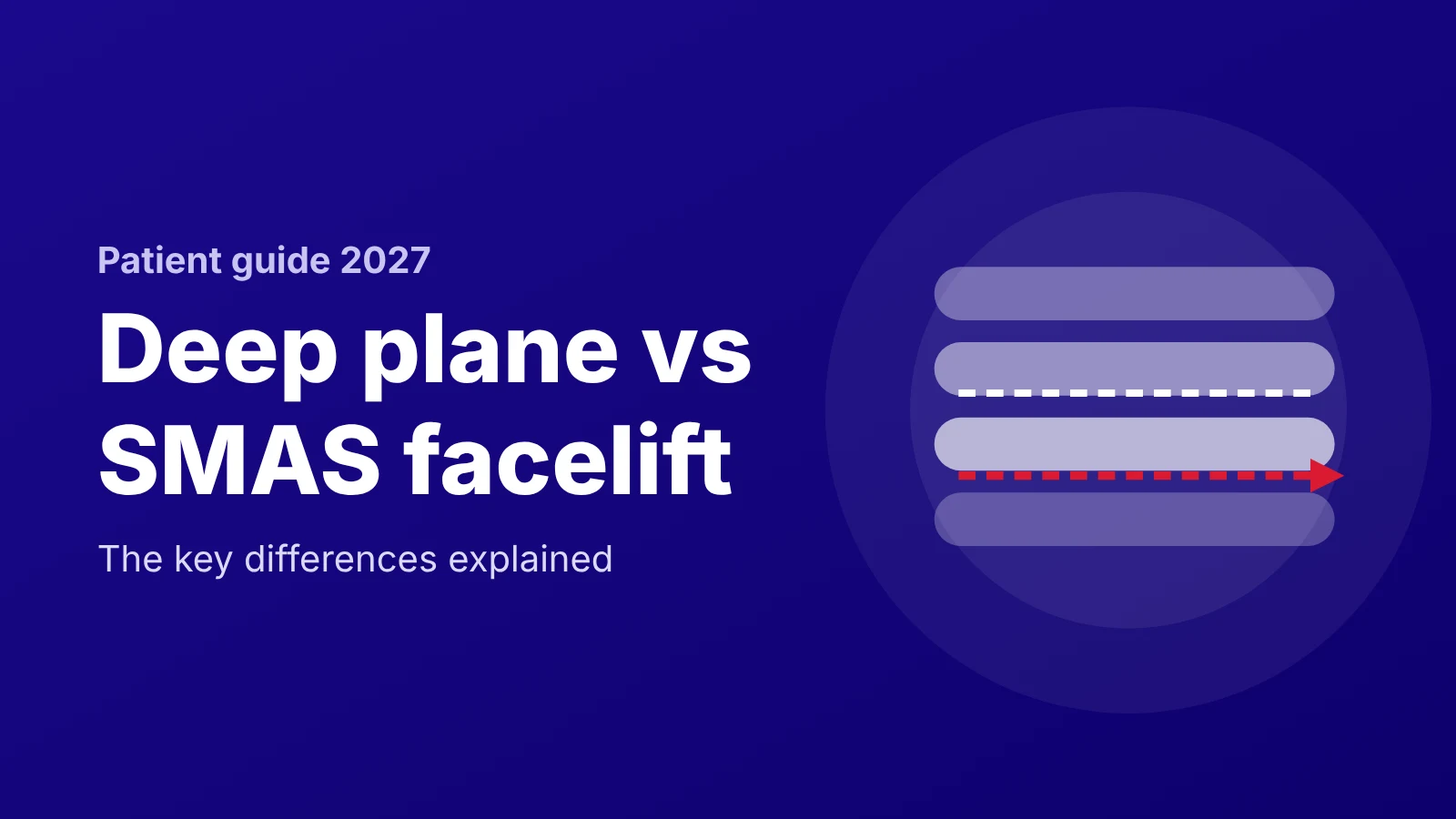
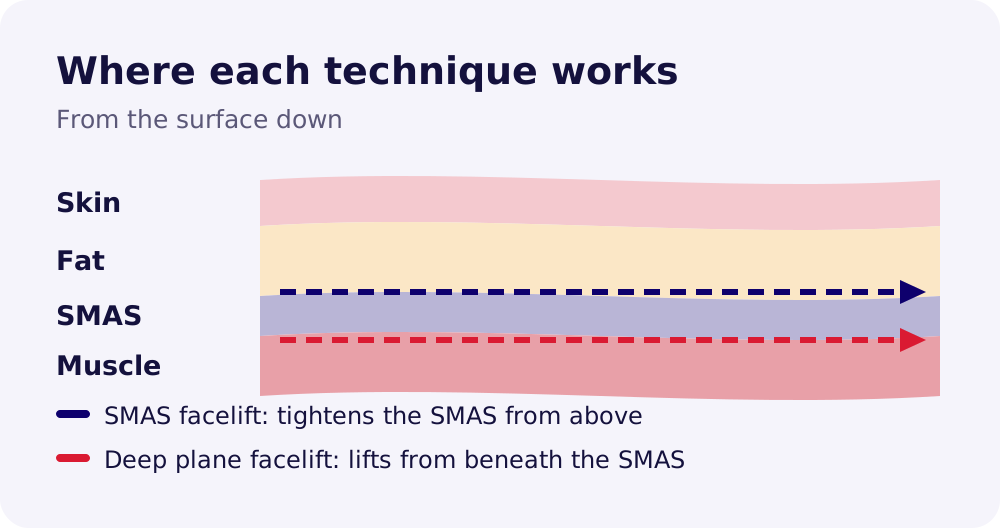
Your face has several layers: skin, a layer of fat, then a sheet of fibrous tissue called the SMAS (superficial musculoaponeurotic system), and below that the muscles of facial expression and the facial nerve branches.
The SMAS is the key to every modern facelift. Older "skin-only" facelifts simply pulled the skin tight, which stretched it and often looked windswept. Today, surgeons lift the SMAS so the support comes from the deeper layer and the skin can sit naturally on top.
How the two techniques differ
SMAS facelift
The surgeon lifts the skin off the SMAS, then tightens the SMAS itself. This can be done by folding and stitching it (SMAS plication) or by removing a strip and stitching the edges together (SMASectomy). The skin is then redraped without tension.
Deep plane facelift
The surgeon goes beneath the SMAS and releases the ligaments that tether the cheek and jaw. The skin, fat and SMAS stay attached to each other and are lifted together as one unit. Because the deeper structures are released, the cheek fat can be moved back up, which a SMAS facelift does less effectively.
Which technique fits which face?
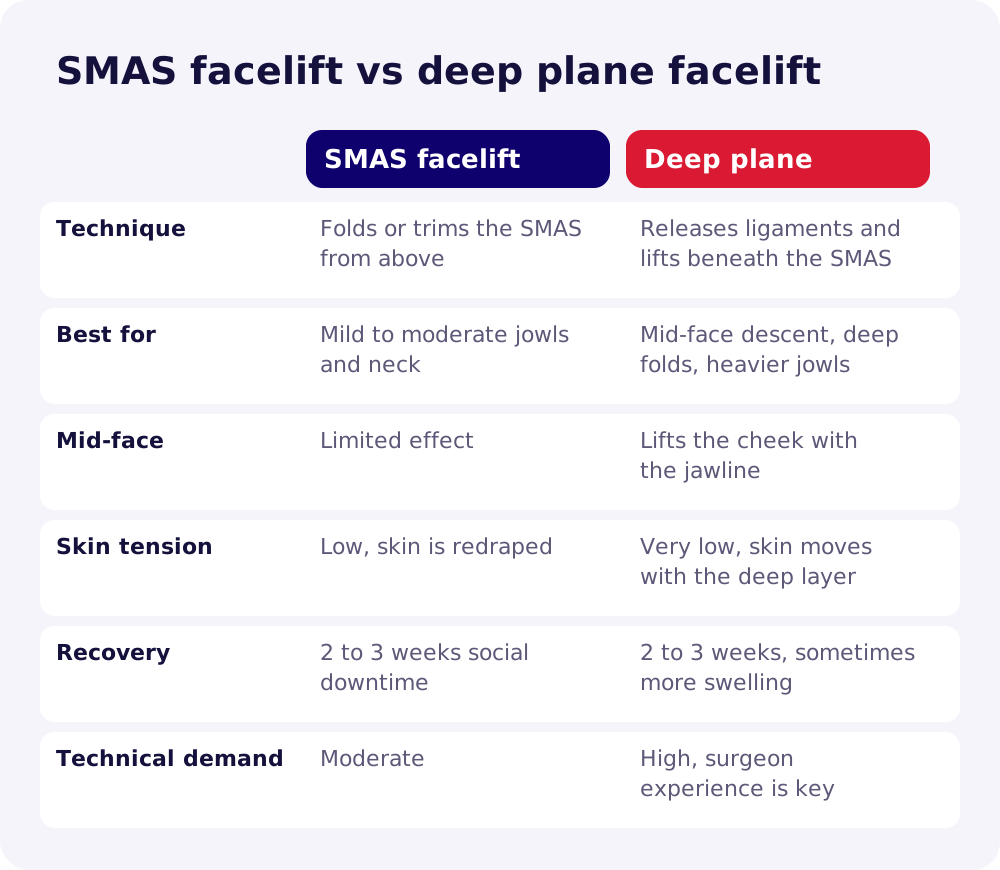
A SMAS facelift often suits you if you have mild to moderate jowls and neck looseness, good cheek volume, and want a refresh with a slightly shorter operation.
A deep plane facelift often suits you if your cheeks have descended, your nasolabial folds are deep, your jowls are heavier, or you have had a previous facelift and want a more complete correction of the mid-face and jawline together.
Neither technique treats the eyes, forehead or skin texture. These are often combined with eyelid surgery, a brow lift, fat transfer or skin treatments.
What does the research say?
Studies comparing the two approaches have not shown that one is clearly better for everyone. Many surgeons get excellent, long-lasting results with each technique. What consistently matters is the surgeon's skill and experience with the technique they use, and how well it suits the patient's anatomy.
Deep plane surgeons often report that the release of the ligaments gives a more natural mid-face and a result that holds well over time. SMAS surgeons point out that their approach involves less dissection around the facial nerve branches. Both arguments are reasonable, and both techniques have a long track record.
Recovery and risks
Recovery is broadly similar. Expect tightness, swelling and bruising for the first one to two weeks, and plan for about 2 to 3 weeks of social downtime. Some patients notice slightly more swelling after a deep plane lift because more tissue is released; others find the skin heals more comfortably because there is less tension on it.
The risks are also similar: a collection of blood (haematoma), temporary numbness, uncommon and usually temporary weakness of a facial muscle, wound healing problems (much more likely in smokers) and visible scarring. Both techniques use similar incisions in front of and behind the ear.
Questions to ask your surgeon
- Which technique do you recommend for my face, and why?
- How often do you perform this technique?
- Can I see before-and-after photos of patients with a similar face and age to mine?
- Will my neck be treated as part of the lift, or separately?
- What would you combine with it, if anything, and what would you leave out?
A good surgeon will explain their choice clearly, and will tell you when a smaller procedure would serve you better.
Facelift in Turkey with Booking Surgery
Facelifts through Booking Surgery are carried out by plastic, reconstructive and aesthetic surgeons, including Dr. Emin Atlı, Dr. Fatih Merev and Dr. Nebil Selimoğlu. Your package includes your consultation, tests, surgery, a private hospital stay of 4 nights with nursing care, medication, meals, transfers, a translator and stitch removal before you fly. A companion can stay with you at no extra cost.
For the full picture of cost, travel and recovery, read our deep plane facelift in Turkey guide.
This guide is general information and does not replace advice from your own doctor or surgeon. Suitability is confirmed after medical assessment. Every operation carries risk, and individual results vary.