In this article
- How much does a gastric sleeve cost in Turkey in 2027?
- What is a gastric sleeve?
- Am I a candidate for a gastric sleeve?
- Your week in Istanbul, day by day
- Recovery after a gastric sleeve
- How much weight will I lose?
- Risks and how they are managed
- Gastric sleeve or gastric bypass?
- Meet your surgeons
- How to get started
At a glance
- Price: £2,000 / €2,350, fixed package price for a primary gastric sleeve
- Hospital stay: 3 nights / 4 days in a private hospital in Istanbul
- Operation: keyhole (laparoscopic) surgery under general anaesthesia, usually 1 to 2 hours
- Time in Turkey: plan for about 7 days in total
- Back to desk work: usually after 1 to 2 weeks
- Aftercare: dietitian plan, starter vitamins and 12 months of remote follow-up
A gastric sleeve is the most commonly performed weight-loss operation in the world, and Turkey has become one of the main places people travel to have it. The reasons are simple: experienced bariatric surgeons, modern private hospitals and a price that is a fraction of what you would pay privately in the UK or Europe.
This guide explains exactly what you pay, what the operation does, what your week in Istanbul looks like, and what life is like in the months that follow. It is written so that you can decide whether a sleeve is worth exploring before you speak to anyone.
How much does a gastric sleeve cost in Turkey in 2027?
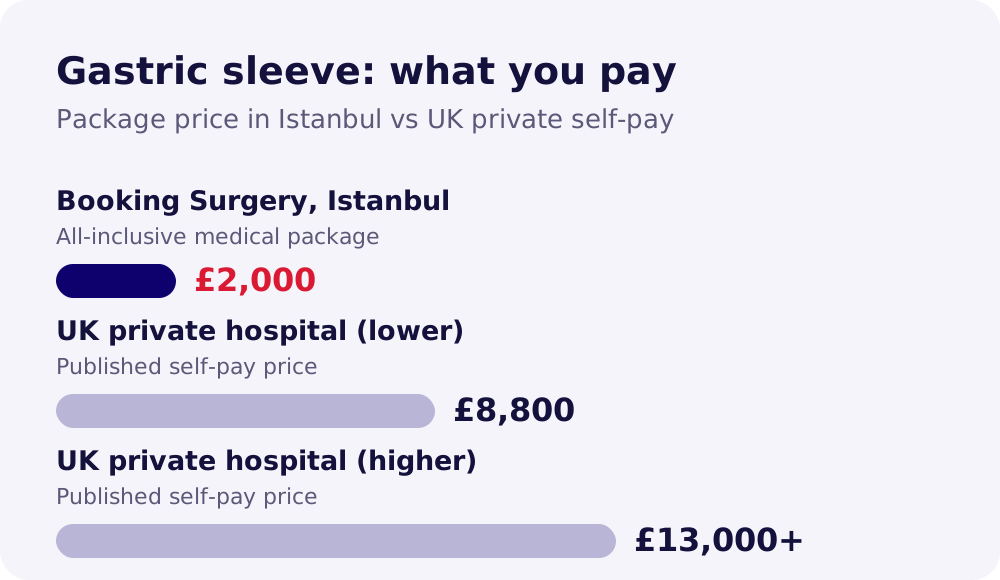
The Booking Surgery gastric sleeve package costs £2,000 or €2,350. It is a fixed price for eligible patients after a medical assessment, and it covers the full medical side of your trip.
| Included in the package | Not included |
|---|---|
| Consultation with your bariatric surgeon | Flights |
| Pre-operative blood tests, ECG and anaesthesia review | Travel insurance |
| Laparoscopic sleeve gastrectomy | Any additional procedures |
| Private hospital stay, 3 nights / 4 days, with 24/7 nursing | |
| Airport and hospital transfers | |
| Medical interpreter and personal patient coordinator | |
| Dietitian consultation and eating plan | |
| Medication and starter vitamins | |
| 12 months of remote follow-up |
For comparison, self-pay prices for the same operation at private hospitals in the UK are commonly listed between roughly £8,800 and £13,000, often before pre-operative tests. Even after adding flights and a few hotel nights, most patients who travel to Istanbul spend well under half of that.
Lower cost in Turkey does not come from cutting corners. It reflects lower hospital running costs, staff costs and exchange rates. What matters is that your quote names the surgeon, the hospital and everything that is included, so you know there will be no surprises. Ours does.
What is a gastric sleeve?
In a sleeve gastrectomy, the surgeon removes around 75 to 80 percent of the stomach and shapes what is left into a narrow tube, roughly the size and shape of a banana. Nothing is rerouted: food still travels the normal way, from the oesophagus through the stomach and into the small intestine.
The sleeve works in two ways:
- Smaller portions. The new stomach holds much less, so you feel full after a few spoonfuls in the early weeks and after a small plate in the long term.
- Less hunger. The part of the stomach that is removed produces most of ghrelin, the hormone that drives appetite. Many patients say the constant pull towards food is the first thing that changes.
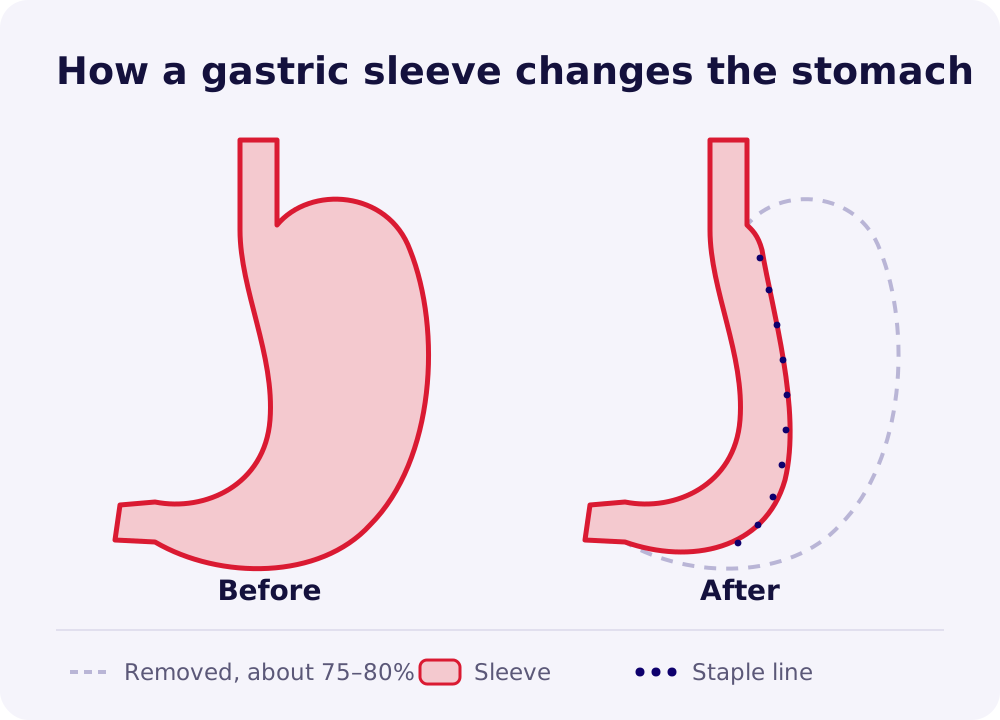
The operation is done through 4 or 5 small incisions using a camera and fine instruments. It usually takes 1 to 2 hours. Because it is permanent, it is a decision to make carefully, but it is also one of the most studied operations in modern surgery.
Am I a candidate for a gastric sleeve?
International guidelines from the American Society for Metabolic and Bariatric Surgery (ASMBS) and the International Federation for the Surgery of Obesity (IFSO), updated in 2022, recommend weight-loss surgery for:
- adults with a BMI of 35 or above, with or without weight-related health problems
- adults with a BMI of 30 to 34.9 who have type 2 diabetes or other metabolic disease that has not improved enough with other treatment
BMI is where the conversation starts, not where it ends. Your surgeon also looks at your medical history, previous operations, medicines and how ready you are for the changes in eating that follow.
A sleeve may not be the best first choice if you already have severe or frequent acid reflux, because a sleeve can make reflux worse. In that case a gastric bypass is often recommended instead. You can read more in our guide to gastric sleeve vs gastric bypass.
Your week in Istanbul, day by day
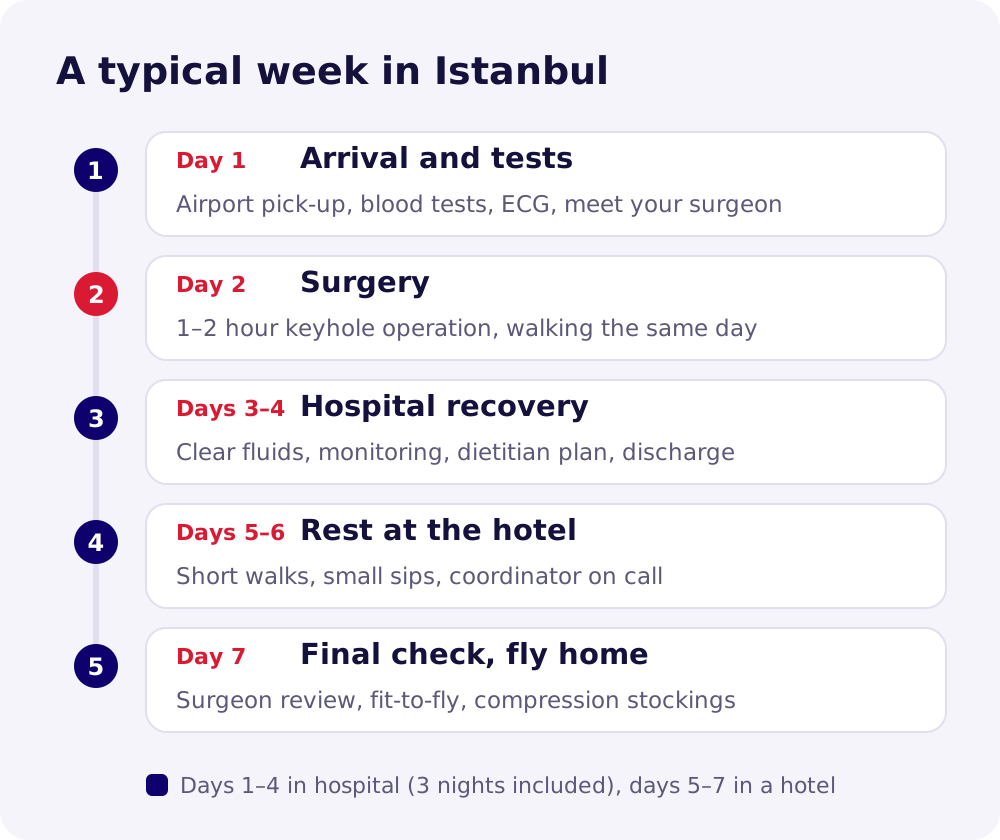
Most patients spend about a week in Turkey. Here is what a typical trip looks like.
Day 1: arrival and tests
Your driver meets you at the airport and takes you to the hospital. You have blood tests, an ECG and any other checks your surgeon needs, then meet your surgeon and anaesthetist. This is your chance to ask every question you have left. Your interpreter stays with you throughout.
Day 2: surgery
You will have been fasting from the night before. The operation takes 1 to 2 hours, and you wake up in recovery before returning to your private room. Nurses will get you up and walking on the same day, which is one of the best things you can do to prevent blood clots and speed recovery.
Days 3 and 4: recovery in hospital
You start with small sips of water and clear fluids. The team checks your pain, fluid intake and wound sites, and monitors you closely for any sign of a complication. Before discharge, the dietitian walks you through your eating plan and you receive your medicines and vitamins.
Days 5 to 7: rest and final check
After discharge, most patients spend a few quiet days in a hotel in Istanbul, walking regularly and sipping fluids. At a final check your surgeon confirms you are recovering well and fit to fly home. Wear compression stockings on the flight, drink as allowed, and walk the aisle when you can.
The hotel is not part of the hospital package, but your coordinator can recommend options near the hospital. If you want more time before travelling, simply plan a longer stay. Some public health guidance suggests waiting around 10 days after abdominal surgery before flying, so discuss the right timing for you with your surgeon.
Recovery after a gastric sleeve
Most patients describe the first week as uncomfortable rather than painful. Wind pain in the shoulders and tiredness are common, and they settle within days. By the end of the second week, many people feel close to normal.
| Activity | Typical timing |
|---|---|
| Walking | From the day of surgery, little and often |
| Desk or home-based work | After 1 to 2 weeks |
| Driving | When you can wear a seatbelt and brake hard without pain, often after 1 to 2 weeks |
| Physical work and lifting | Usually after 4 to 6 weeks |
| Gym, running and swimming | Gradually from around 4 to 6 weeks, once wounds have healed |
The diet stages
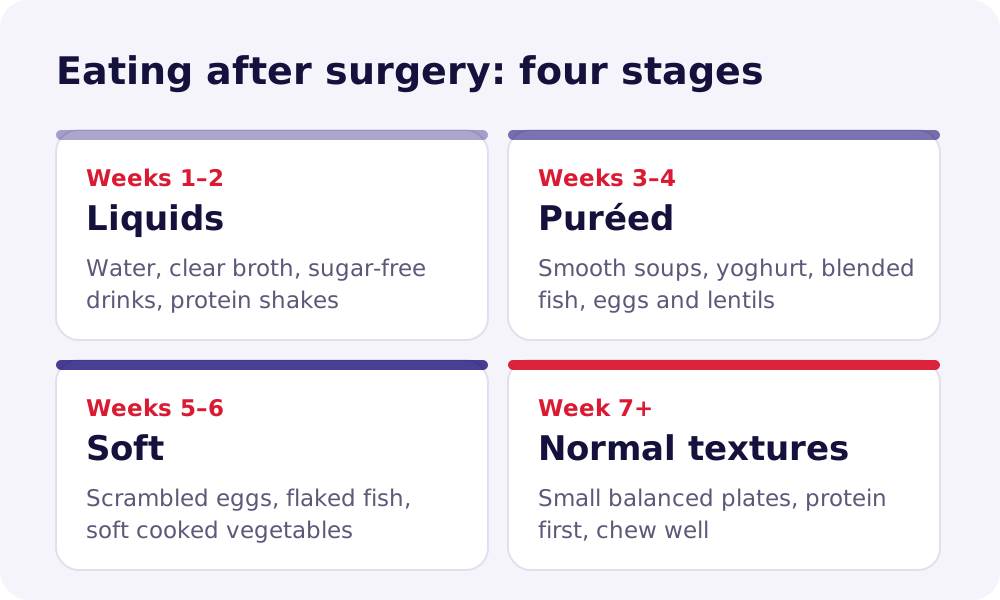
Your new stomach needs time to heal, so you return to normal food in stages over about 6 to 8 weeks. Your dietitian gives you a detailed plan, but the general pattern looks like this:
A few habits make the biggest difference from the start:
- Protein first at every meal, to protect muscle while you lose weight.
- Sip, don't gulp. Aim for about 1.5 to 2 litres of fluid a day, taken slowly between meals rather than with them.
- Eat slowly and stop at the first sign of fullness.
- Take your vitamins every day. After a sleeve you will need a multivitamin and other supplements for life, plus regular blood tests.
How much weight will I lose?
Weight loss is fastest in the first 6 months and usually reaches its lowest point between 12 and 18 months after surgery. Many patients lose around a quarter to a third of their starting body weight by that point.
Long-term results depend heavily on the habits you build in the first year. The Finnish SLEEVEPASS trial, which followed patients for 10 years, found that people who had a sleeve still maintained an average of about 43 percent loss of their excess weight a decade later. Some weight regain over the years is common, which is why follow-up, activity and good eating patterns matter long after you leave Istanbul.
Weight is only part of the picture. Many patients see improvements in type 2 diabetes, blood pressure, sleep apnoea and joint pain, along with energy and confidence. These benefits vary from person to person, and your surgeon can explain what is realistic for you.
If you are thinking about medication instead, our guide to gastric sleeve vs Ozempic and Mounjaro compares the two approaches.
Risks and how they are managed
Every operation carries risk, and a good decision is an informed one. The main risks of a gastric sleeve are:
- Staple-line leak. The most serious early complication. It is uncommon, reported in roughly 1 to 2 percent of patients in published series, and is why you are monitored closely in hospital.
- Bleeding from the staple line, usually in the first days.
- Blood clots in the legs or lungs. Early walking, compression stockings and blood-thinning injections reduce this risk.
- Acid reflux. Reflux can start or get worse after a sleeve. In the SLEEVEPASS trial, around half of sleeve patients reported worse reflux symptoms after 10 years. Many manage it with medication; a small number later need a bypass.
- Vitamin and mineral deficiencies, especially iron, vitamin B12 and vitamin D, if supplements are not taken.
- Loose skin after major weight loss, which some patients later choose to treat with body contouring.
Get urgent medical help if you notice
- a fast heart rate, fever or shivering
- worsening tummy pain, or pain in the left shoulder
- shortness of breath or chest pain
- a painful, swollen leg
- vomiting, or being unable to keep fluids down
Contact your local emergency services first, then let your Booking Surgery coordinator know.
Gastric sleeve or gastric bypass?
Both operations work well, and both are done laparoscopically. The right choice depends mainly on your reflux, your diabetes and your medical history.
| Gastric sleeve | Gastric bypass | |
|---|---|---|
| How it works | Removes about 75 to 80% of the stomach | Creates a small pouch and reroutes the intestine |
| Hospital stay | 3 nights / 4 days | 4 nights / 5 days |
| Package price | £2,000 / €2,350 | £2,700 / €3,150 |
| Reflux | Can start or worsen reflux | Often improves reflux |
| Long-term weight loss | Very good | Slightly greater on average |
| Reversible | No | Technically possible, but rarely done |
See the full details on our gastric sleeve and gastric bypass pages.
Meet your surgeons
Gastric sleeve surgery through Booking Surgery is performed by experienced bariatric surgeons, including Assoc. Prof. Dr. Ali Tardu and Assoc. Prof. Dr. M. Kağan Katar. Both are general surgeons who specialise in bariatric and metabolic surgery, and you can read their full profiles on our gastric sleeve page.
Before you book, your surgeon reviews your details and confirms whether a sleeve is the right operation for you. If it is not, they will tell you, and explain what they would recommend instead.
How to get started
- Send your details. Share your height, weight, health conditions, medicines and any previous operations through our short form.
- Get your free plan. Your surgeon reviews your case and you receive a personal treatment plan with dates and a clear, fixed price.
- Book your trip. Your coordinator organises your transfers, hospital admission and interpreter, and stays in touch from your first message to your 12-month follow-up.
This guide is general information and does not replace advice from your own doctor or surgeon. Suitability is confirmed after medical assessment. Every operation carries risk, and individual results vary.