In this article
- Who does what in a surgery trip?
- 1. Check the surgeon
- 2. Check the hospital
- 3. Use official sources
- 4. Compare written quotes properly
- 5. Plan aftercare and insurance before you book
- 6. Read reviews and photos carefully
- Red flags to watch for
- Questions to ask before you pay a deposit
- How Booking Surgery works
The 6 checks that matter most
- Named surgeon: you know who will operate, and they are a specialist in that operation
- Named hospital: a licensed private hospital, not an unnamed "clinic"
- Official listing: the provider can be checked through HealthTürkiye and the Ministry of Health
- Written quote: exactly what is included, what is not, and what happens if plans change
- Aftercare plan: who you contact after you get home, and how quickly they respond
- Honest assessment: the surgeon reviews your case and is willing to say no
Turkey is one of the world's most popular destinations for surgery abroad, from weight-loss surgery to facelifts and tummy tucks. Most patients have a good experience. But because there are many agencies and clinics, choosing well takes a little homework.
This guide gives you a clear checklist to compare providers, red flags to watch for, and the questions to ask before you pay a deposit.
Who does what in a surgery trip?
Most surgery trips involve three parties, and it helps to know who is responsible for what:
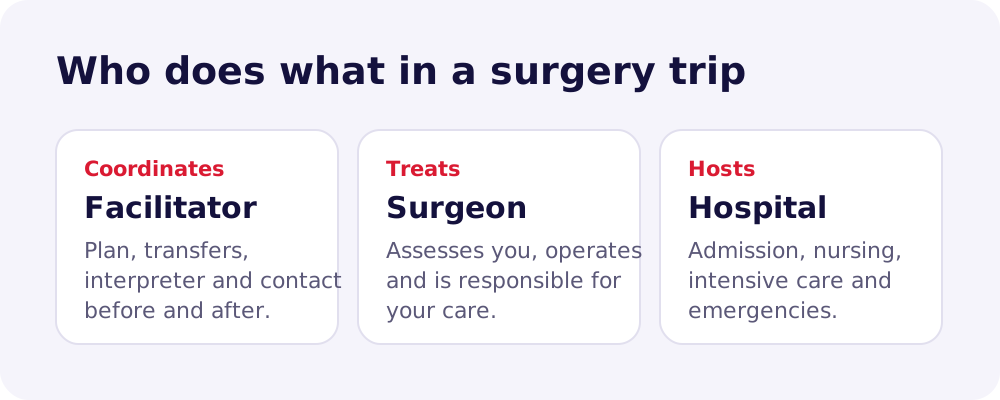
- The facilitator (such as Booking Surgery) organises your plan, transfers, interpreter and communication, and stays in touch before and after surgery.
- The surgeon assesses you, decides whether surgery is suitable, performs the operation and is clinically responsible for your care.
- The hospital provides the operating theatre, anaesthesia team, nursing, intensive care if needed, and emergency support.
1. Check the surgeon
Ask for the full name of the surgeon who will operate, not just the clinic's name. Then check:
- their specialty: plastic, reconstructive and aesthetic surgery for cosmetic procedures, or general surgery with a bariatric focus for weight-loss surgery
- how often they perform your specific operation
- their academic title and hospital affiliations, which are usually listed on hospital websites
- whether you will meet them before surgery, and whether they will see you after
Be wary if the surgeon is only named on the day, or if a different doctor appears in your paperwork.
2. Check the hospital
Your operation should take place in a licensed private hospital with an intensive care unit on site or a clear transfer plan. Ask:
- the exact name and address of the hospital
- whether there is an intensive care unit, and a doctor on site overnight
- how many nights you will stay, and who pays if you need longer
- whether you will get your operation notes and discharge summary in English
3. Use official sources
Turkey regulates health tourism. HealthTürkiye is the official health tourism platform supported by the Turkish Ministry of Health, and hospitals and intermediary companies working in health tourism need Ministry authorisation. You can ask any provider for their authorisation details and check that the hospital is a recognised private hospital.
International accreditation, such as JCI, is another useful sign that a hospital meets international standards, although many good Turkish hospitals are not JCI accredited.
4. Compare written quotes properly
The cheapest headline price is rarely the best value. Put quotes side by side and compare:
| Check | What a good quote shows |
|---|---|
| Operation | The exact procedure, the surgeon and the hospital |
| Tests | Which blood tests, scans and reviews are included |
| Hospital stay | Number of nights, and the cost of extra nights if needed |
| Travel | Transfers, interpreter, and whether hotel nights are included |
| Aftercare | Medication, garments, follow-up contact and for how long |
| Changes | Deposit, cancellation terms and what happens if the plan changes |
5. Plan aftercare and insurance before you book
Most problems after surgery appear in the first few weeks, often after you get home. Before booking, make sure you know:
- who to contact for a routine question and for an urgent concern
- when you are likely to be fit to fly, and how much time to allow
- whether your travel insurance covers medical treatment abroad, as many standard policies exclude planned surgery
- whether complication insurance is available
- how to share your operation records with your GP or local doctor
6. Read reviews and photos carefully
Reviews and before-and-after photos are useful, but look for patterns rather than single stories. Prefer reviews on independent platforms that mention the surgeon by name, describe the aftercare, and are spread over time. Before-and-after photos are most useful when they show similar patients, similar angles and lighting, and enough time after surgery.
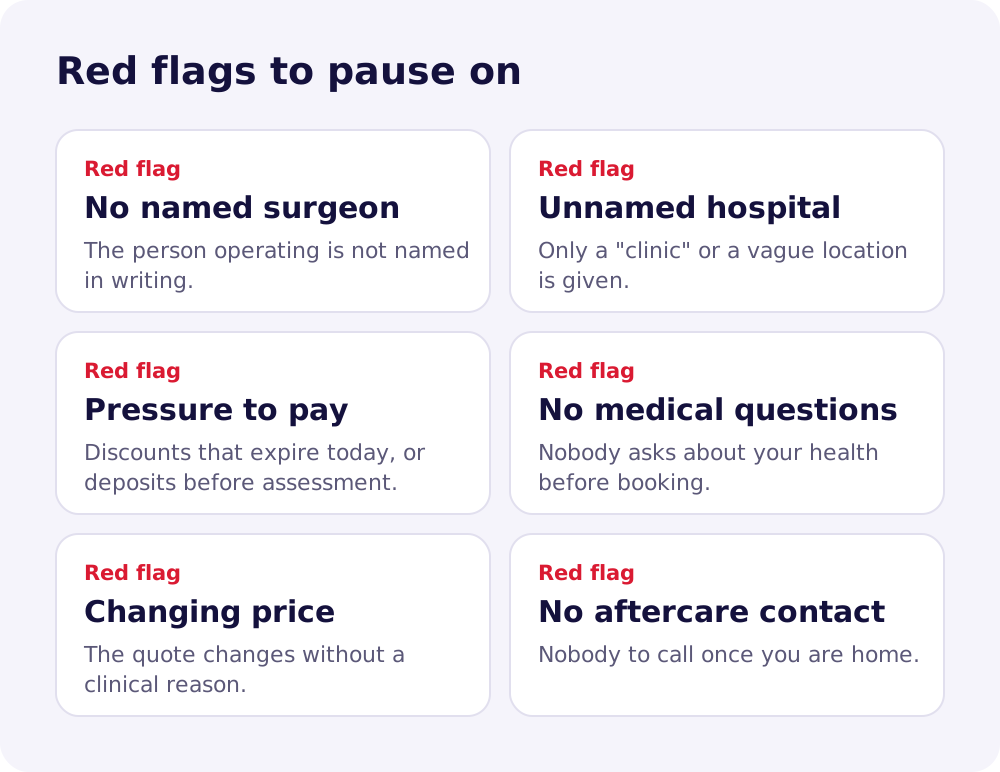
Red flags to watch for
Questions to ask before you pay a deposit
- Who will perform my surgery, and how often do they do this operation?
- Which hospital will I be admitted to?
- Has the surgeon reviewed my medical history and photos?
- What exactly is included in the price, and what is not?
- What happens if I need to stay longer, or if there is a complication?
- Who do I contact after I get home, and how quickly will they reply?
- Will I receive my operation notes and discharge summary in English?
How Booking Surgery works
We built our process around these checks. Before you book, your surgeon reviews your details and confirms whether the operation is suitable. You receive a written plan that names your surgeon and hospital, lists exactly what is included and gives a fixed price. A dedicated coordinator and interpreter support you from your first message, through your hospital stay, and during your follow-up at home.
Our surgeons include bariatric surgeons Assoc. Prof. Dr. Ali Tardu and Assoc. Prof. Dr. M. Kağan Katar, and plastic surgeons Dr. Emin Atlı, Dr. Fatih Merev and Dr. Nebil Selimoğlu. You are welcome to check their names and hospitals yourself before you decide.
This guide is general information and does not replace advice from your own doctor. Every operation carries risk, and individual results vary.